Smart Investing Is About Building Positions, Not Timing the Market
A disciplined strategy to accumulate quality smart money stocks across market cycles
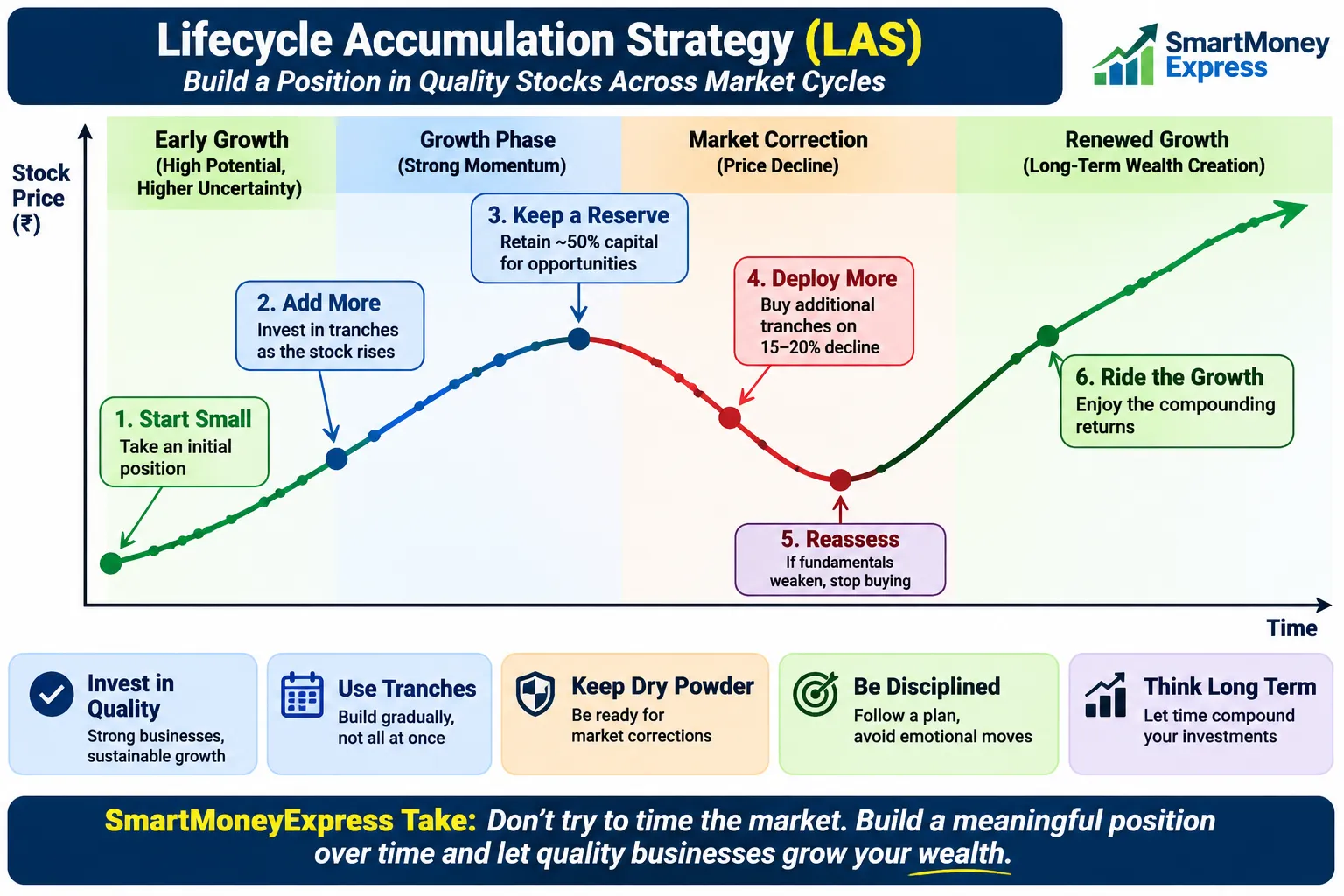
Most investors spend too much time trying to identify the perfect price to buy a stock. Experienced investors understand that building wealth is less about getting the entry point right and more about accumulating exceptional businesses at sensible valuations over time.
One approach popularised by investor and YouTube financial commentator Tom Nash combines systematic investing with the opportunity to deploy additional capital during market corrections. Its central idea is simple: keep investing in quality businesses while retaining some capital to take advantage of meaningful price declines.
At SmartMoneyExpress, we call this the Lifecycle Accumulation Strategy (LAS).
How does the strategy work?
1. Identify quality businesses, not just attractive stocks
Start by identifying companies with strong competitive advantages, capable management, healthy balance sheets, sustainable earnings growth and attractive long-term prospects. Institutional buying, promoter activity and increasing ownership by experienced investors can provide additional research clues. However, smart-money activity should complement, not replace, fundamental analysis.
2. Build your position gradually
Instead of committing your entire intended investment at once, divide your allocation into smaller tranches. Establish an initial position and continue accumulating at predefined intervals. This ensures participation if the stock appreciates without requiring you to predict its next move.
3. Keep capital ready for market corrections
A useful approach is to deploy approximately 50% of the available investment allocation through regular purchases and retain the balance in relatively low-risk, liquid instruments. When a fundamentally sound stock experiences a meaningful correction, the reserve can be deployed in additional tranches.
For example, a 15–20% decline in a stock may warrant closer examination and an additional purchase if earnings prospects, competitive positioning and the original investment thesis remain intact. A falling share price alone is never a reason to buy more.
4. Invest differently as the company matures
A company's investment lifecycle matters. An emerging growth business may offer substantial upside but carry higher uncertainty. As it establishes market leadership and demonstrates consistent profitability, investors may build conviction and increase exposure. Mature companies may warrant a different accumulation approach, with greater emphasis on cash flows, dividends and valuation.
When growth deteriorates, competitive advantages weaken or the original investment thesis breaks, accumulation must stop. Capital preservation becomes more important than averaging down.
The bigger picture: Let volatility work in your favour
The objective is not to catch every market bottom or trade every correction. It is to develop a repeatable investment process that removes emotional decision-making, encourages disciplined accumulation and allows investors to participate in long-term wealth creation.
The strategy also requires patience, adequate liquidity, portfolio diversification and periodic reassessment. A good company is not necessarily a good investment at every price, and no amount of averaging can rescue a permanently deteriorating business.
SmartMoneyExpress Take: Successful investing is not about buying everything at its lowest price. It is about identifying businesses with the potential to compound wealth and building meaningful positions as opportunities emerge across market cycles. Invest with conviction, accumulate with discipline and let time do the heavy lifting.
Disclaimer: This article is for educational and informational purposes only and does not constitute investment advice or a recommendation to buy or sell any security. Investors should conduct independent research and assess their risk appetite before investing.
Smart Money Express publishes financial journalism, not investment advice. Nothing here is a recommendation to buy or sell any security. Flow indicators describe observed institutional activity over a stated period; they are not ratings and carry no view on future prices. Do your own research or speak to a registered adviser.
More from Insights
Comments
No comments on this piece yet. Yours would be the first.
Leave a comment
Comments are read before they appear. Your email address is never published.
Please keep it civil and on the subject of the article. We remove anything defamatory, and we cannot answer questions about what to buy or sell.